
Tesori d'Europa on the Road to the World Longevity Summit 2027: From Kyotango to Salsomaggiore, a Bridge Between Italy and Japan for a New Culture of Longevity
Tesori d'Europa officially announce their participation in the international "Toward World Longevity Summit 2027" initiative, alongside Fondazione Ravasi Garzanti, the University of Milano-Bicocca, the Municipality of Salsomaggiore Terme, and the Italian and Japanese institutions, scientific organizations and other stakeholders involved in the initiative.
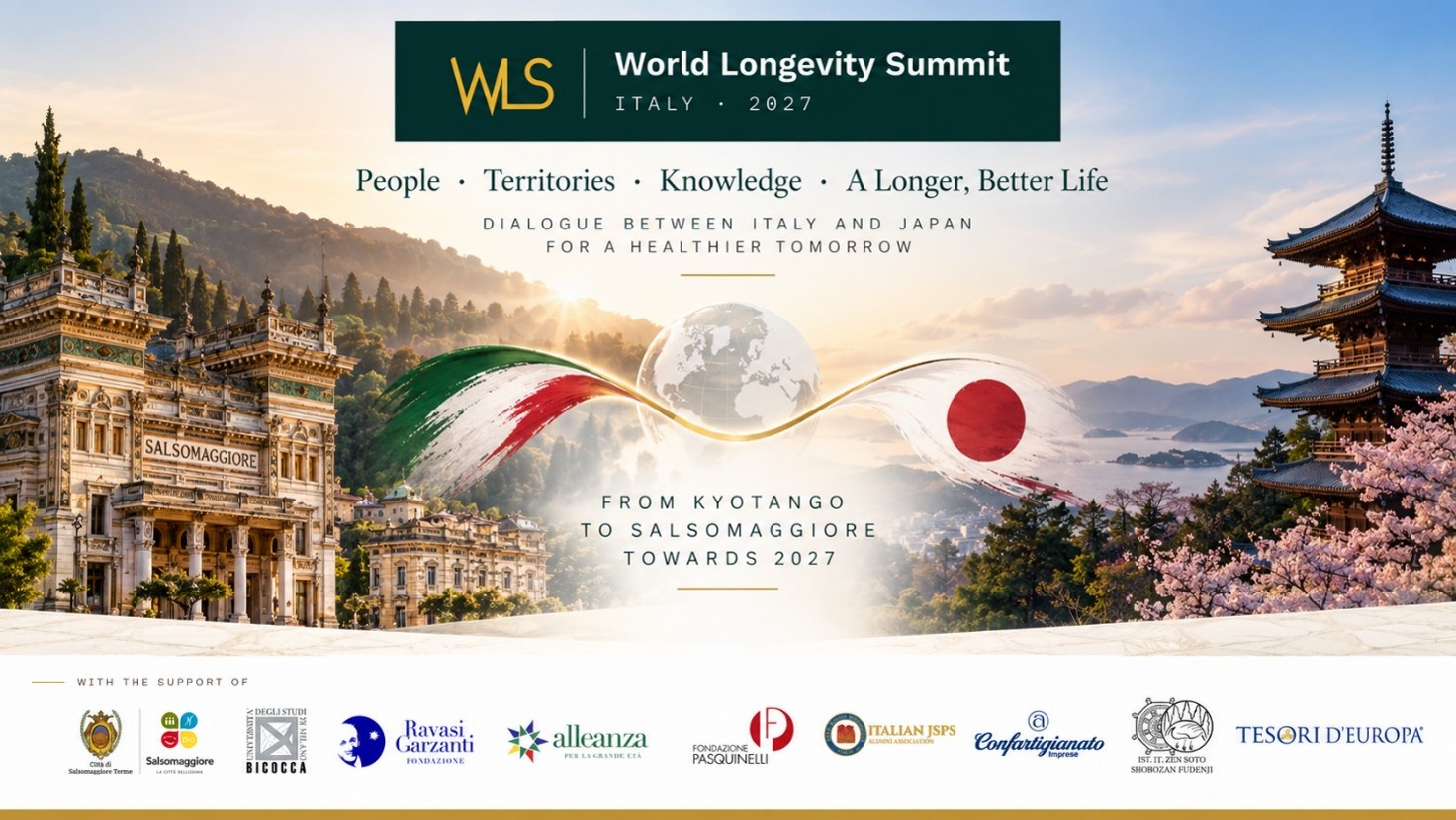
The project represents the journey leading up to the second edition of the World Longevity Summit, scheduled to take place in Italy in 2027, following the first edition held in 2025 in Kyotango, Kyoto Prefecture, an area internationally renowned for its culture of longevity and a way of life deeply rooted in community.
These days, Salsomaggiore Terme and Milan are hosting four days of dialogue between the Japanese scientific delegation and Italian institutions, universities, foundations, organizations, and representatives of the economic and social sectors. Fondazione Ravasi Garzanti, the Municipality of Salsomaggiore Terme and the University of Milano-Bicocca are directly involved in organizing this journey.
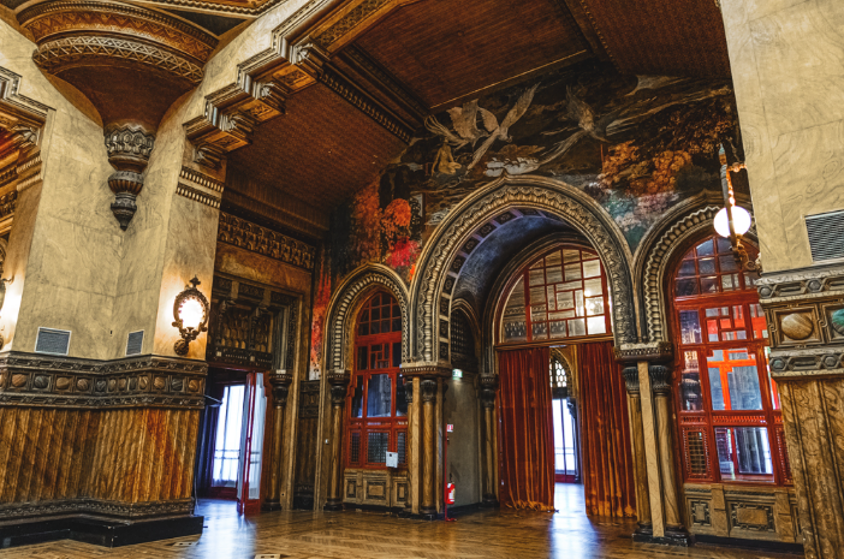
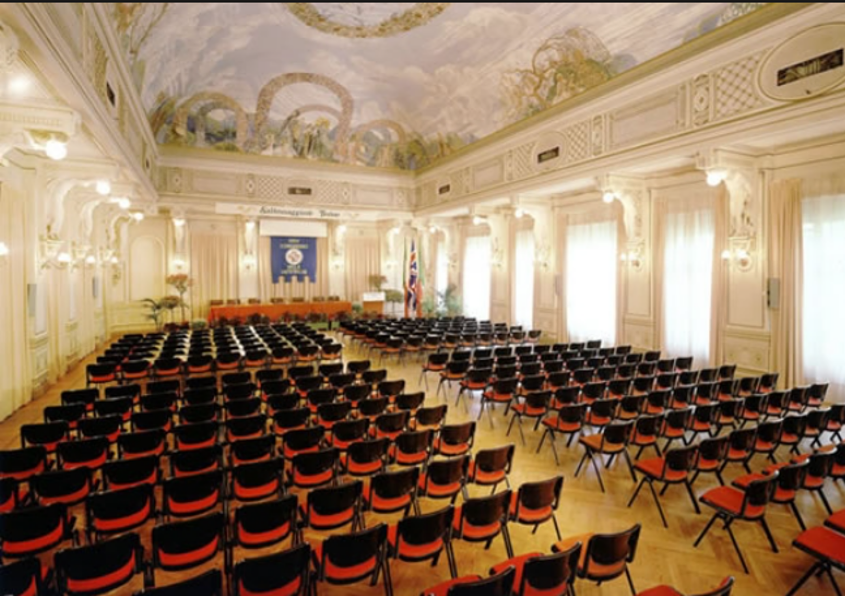
Palazzo dei Congressi, Salsomaggiore Terme.
The opening day, held on September 15, 2026, at the Palazzo dei Congressi in Salsomaggiore Terme, marked the first major opportunity for dialogue between the experience developed in Japan and the Italian perspective on the World Longevity Summit 2027.
Following welcoming remarks by the Mayor of Salsomaggiore Terme, Luca Musile Tanzi, and an introduction by Professor Stefania Bandini of the University of Milano-Bicocca, Professor Satoaki Matoba of Kyoto Prefectural University of Medicine, a key figure since the first Kyotango Summit, presented the journey "Towards World Longevity Summit 2027: from Kyotango to Salsomaggiore Terme". The session also included a video message from the Mayor of Kyotango, Yasushi Nakayama.
The Japanese scientific delegation then addressed some of the key issues currently shaping international research on longevity. Yuji Naito, from Kyoto Prefectural University of Medicine, explored the relationship between nutrition, the gut microbiome and frailty among Kyotango's elderly population; Tomoo Matsuda, from the Mitsubishi Research Institute, presented the Platinum Society model for societies characterized by significant demographic ageing; Sae Kondo, from Mie University and RCAST – University of Tokyo, addressed the relationship between urban planning, longevity and community mutual-support systems; while Katsuhiro Nishinari, from the University of Tokyo, focused on pedestrian mobility and the development of urban environments capable of promoting health and longevity.
Professor Matteo Colleoni, Full Professor of Urban Studies at the University of Milano-Bicocca, also contributed to the discussion, strengthening the Italian academic dimension of a dialogue that places particular emphasis on the relationship between longevity, the organization of urban spaces, mobility, quality of life and social transformation.
The discussion made it clear that longevity can no longer be regarded exclusively as a medical or demographic issue. Instead, it requires a multidimensional approach encompassing health, prevention, nutrition, social relationships, urban planning, the environment, technological innovation, participation in community life and quality of life. This is precisely the vision underpinning the World Longevity Summit.
The scientific session was followed by contributions from Italian institutional representatives, including Elisabetta Donati, Chair of the Research and Culture Area at Fondazione Ravasi Garzanti; Marco Granelli, President of Confartigianato Imprese; and Riccardo D'Urso, President of Tesori d'Italia and founder of Tesori d'Europa.
The participation of Tesori d'Italia and Tesori d'Europa in this journey reflects their commitment to contributing to a model of longevity capable of connecting scientific research, businesses, territories and communities, while integrating longevity into broader development and territorial regeneration strategies.
Longevity will, in fact, be one of the key themes of the Territorial Regeneration programme within the 2027–2030 National Plan for the Protection and Promotion of Made in Italy, based on the principle that individual well-being cannot be separated from the well-being of the community and the territory in which each person lives.
This is where longevity directly meets the One Health paradigm: the health of individuals, the environment and territories, together with the economic and social well-being of communities.
Tesori d'Italia is developing this approach through its own network of specialist expertise. The Salsomaggiore meeting was also attended by Prof. Antonio Carlo Galoforo, Brand Ambassador of Tesori d'Italia and Member of the Environment and Health Technical Committee of the "One Health" Parliamentary Intergroup, underscoring the commitment to establishing an increasingly close connection between longevity and an integrated vision of the health of individuals, the environment and communities.
It is precisely in this context that the dialogue between Italy and Japan takes on particular significance.
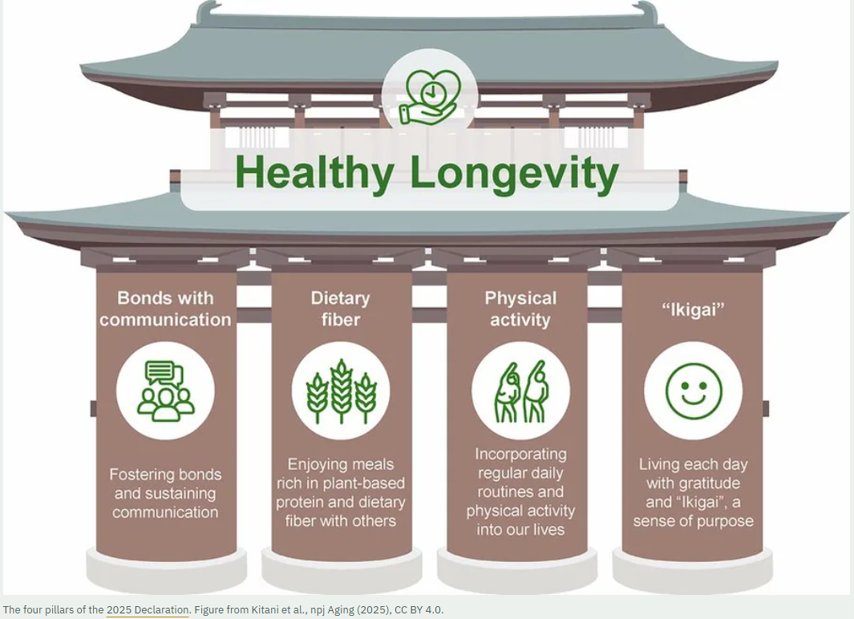
The four pillars of the 2025 Declaration. Figure from Kitani et al., npj Aging (2025), CC BY 4.0.
Japan brings to the international debate a culture of prevention, discipline, balance between the individual and the community and, above all, the concept of Ikigai — a reason to get up every morning. On the other side of this bridge, Italy can contribute its Mediterranean culture, food traditions, the central role of the family, the social fabric of its communities, and the immense human, cultural and environmental heritage of its territories.
It is no coincidence that the World Longevity Summit programme identifies four interconnected dimensions of healthy ageing: human relationships and social participation; food culture and the Mediterranean Diet; active lifestyles; and gratitude, purpose and Ikigai. These are complemented by scientific research, prevention, and the responsible use of digital technologies and artificial intelligence to support healthy ageing and social inclusion.
The Italian journey does not end with the opening meeting. The Salsomaggiore programme also includes sessions exploring the relationship between longevity and spirituality, with a visit to the Fudenji Monastery, as well as the relationship between longevity, well-being and thermal heritage, through dialogue with the Salsomaggiore and Tabiano thermal spas.
On September 18, the programme will move to Milan, at Fondazione Pasquinelli, for a day dedicated to the *Alleanza per la Grande Età*, promoted by Fondazione Ravasi Garzanti together with several local partners as a community-based welfare model for longevity. Participants will include, among others, the Consulate General of Japan in Milan, the Municipality of Milan, Fondazione Ravasi Garzanti, the JSPS Strasbourg Office, and several organizations active in research, care, culture and community participation.
The patronage of and participation in the journey towards the World Longevity Summit 2027 represent a concrete commitment for Tesori d'Italia and Tesori d'Europa. They will support the project through their communication channels and by engaging their business and institutional networks, helping to create new opportunities for dialogue and cooperation among research, institutions, businesses and territories.
The goal is to transform the Kyotango–Salsomaggiore journey into a permanent laboratory for cooperation between Italy and Japan, capable of generating concrete projects in the fields of longevity, prevention, One Health, innovation and territorial regeneration.
This cooperation can also take on a broader European dimension, creating new opportunities for dialogue among Italy, Europe and Japan and connecting scientific expertise, territorial systems and entrepreneurial capabilities.